Dave Glover
Orchestra /
Showband
(1952-1970)
Photo Gallery -
Band Lineups -
Discography
- Audio samples -
Where Are They Now?
The Story
Dave Glover once claimed credit
for
coining the term "showband" even though the Clipper Carlton are
generally regarded as the band that first popularized
this uniquely Irish form of entertainment. Validating his claim is
difficult as the first mention we can find of the Dave Glover
Showband was in December, 1956.
One way or another, Dave's story starts with his birth in 1925 in a fire
station in Ardoyne, youngest of four children. All his brothers played
instruments: Ollie (tenor sax), John (trombone) and Sam (tenor sax)
played with Dave on his trumpet and his mother on piano.
Growing up in Belfast, he and his
brothers played with the Belfast Military band. When he was in his
early teens he joined the Whitehurst Silver Band, a local marching
band. A few of the lads got together and formed a group that played
in the local pubs. He first took a job as a
fitter in the Short and Harlands shipyards and learned a trade, before setting
off for a career in music. In 1945, he played trumpet for the summer
in the Queens Ballroom and in 1946 he was in Milanos Ballroom with
Jimmy Montague. In 1947, he turned 21 and started his professional
career
as the trumpet player with the Bob Robinson Orchestra which was the
resident band in the Floral Hall in Belfast for
£7-10 schillings a week.
However, in
1948 he left the orchestra and formed a four piece group which
played functions and dinner dances in Belfast. Dave took the big
plunge in late 1952 when he formed his own 14 piece orchestra and was they
were listed in adverts for the band as the "resident band in the
Midland Hotel in Belfast."
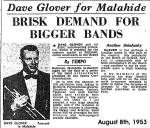
In the summer of 1953, Dave and
his Orchestra became the summer resident
band in the newly built Arcadia ballroom in Portrush. This
was a relationship he would maintain for over a decade, performing
there as the resident band every summer. In 1956, Dave added a 20
minute "show" to the act and changed the name of the band to the
Dave Glover Showband, the first band to use the term in their name.
In a 1989 BBC interview Dave admitted he got the idea from the
Clipper Carlton and that the term, "showband" term grew out of "Crazy
Night" in which he let the band smoke and drink on stage, as long as
they dressed up and were willing to do a skit or two. From that came
the idea of the cabaret "show" in the middle of the dance.
The first actual instance in an advert of "Dave Glover Showband" we
can find was in December, 1956.
Interestingly enough, Dave talked
about the conditions that helped lead to the downfall of the
showbands. In the early days, bands played the full four hours from
9 to 1 am (or with Long Dances from 9 until 3 a.m.). As bands became more successful, Dave feels they became
lazy and started to substitute an inferior relief band for the band's
first two hours. (Editor's note: Of course, in later years, even the relief bands
would be replaced by discos!)
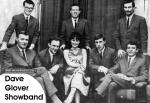
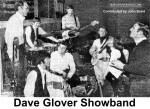
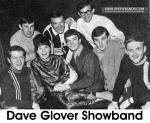
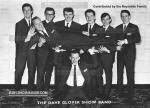
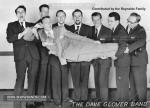
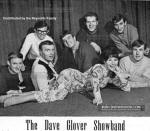
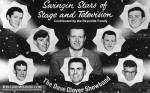
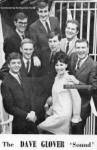
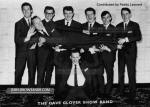
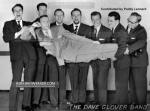
The original Dave Glover "Showband"
included Dave (trumpet), Gerry Rice (sax), Andy Wilson (trombone),
Joe Clarke (vocals), Alex Burns (guitar), Jackie Flavelle (bass),
Davy Martin (drums) and Harry Mitchell (keyboards). The band would
play the summer seasons in Portrush and spend the rest of the year
touring the ballrooms of Ireland. Harry Hamilton joined the band on
bass in 1961 when he swapped jobs with Jackie Flavelle, Jackie going
to Johnny Quigley's band.
Strangely enough, the band split
in 1963, just as the showband era was in full swing. Everyone but
drummer Davy Martin left and formed the Witnesses Showband, who
recruited George Mullen on trumpet to replace Dave. The Witnesses
would go on to their own fame and fortune, touring extensively
outside Ireland and gaining a reputation for one of Ireland's most
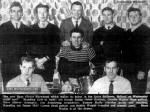
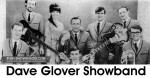
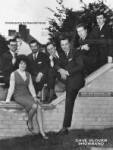
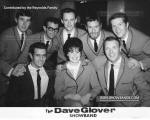
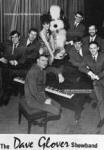
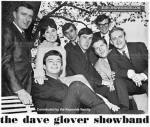
musical bands. Dave recruited a new lineup which included
Gough Glenn (clarinet), Charlie Walker (bass), Jim Armstrong
(trombone), Tommy Duffy (guitar and vocals), Jim Carson (guitar) and
Bobby Wright (vocals).
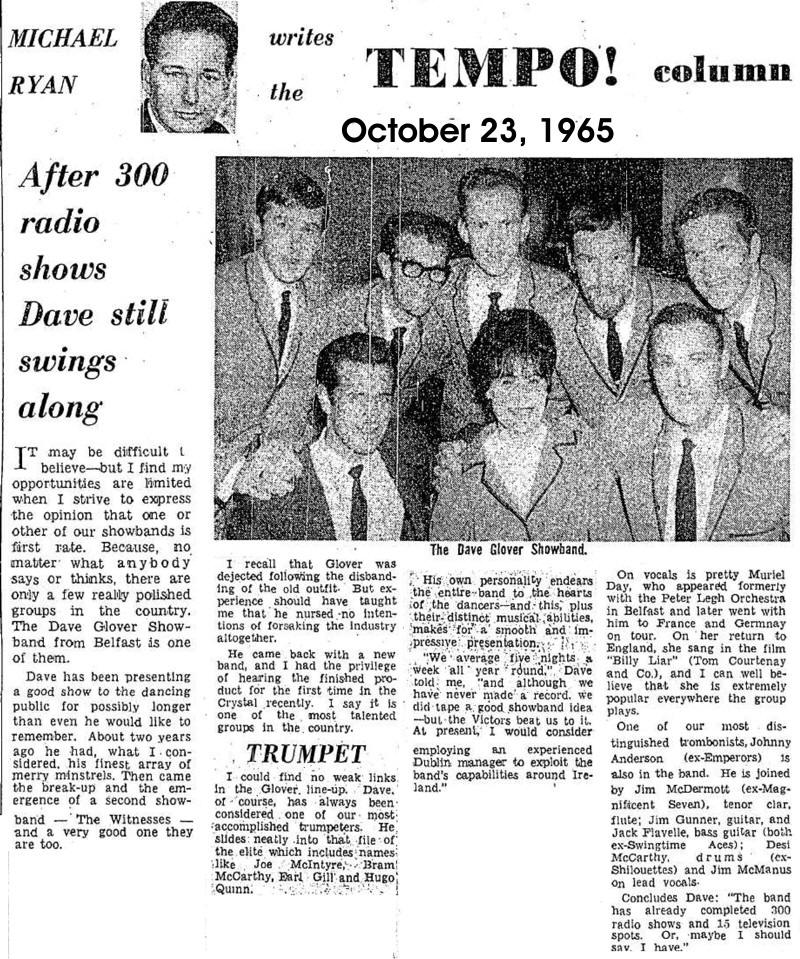
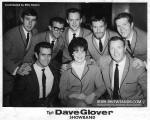
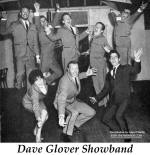
The new lineup clicked with the
dancing public and really took off. They were one of the first to
feature both a male and female lead vocalist which gave them great
range when covering the hits of the day. Throughout the 1960's the
band continued to be one of the major draws across the country and
toured extensively in England, playing the Irish clubs abroad. In
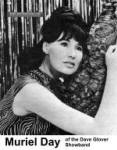
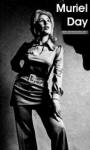
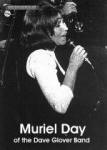
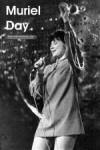
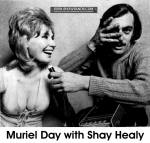
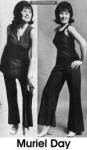
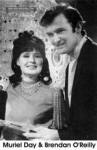
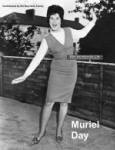
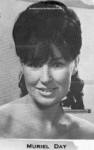
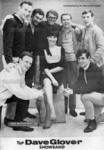
April, 1965, Muriel Day (real name Galway) joined the band as she
had married Dave about a year earlier. Muriel had been singing in
England and sang a song in the film, "Billy Liar" before returning
home to Ireland to marry Dave. She was an instant hit with fans.
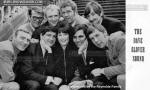
In 1966 George Jones, former
bandmate of Van Morrison in the Monarchs Showband, joined on bass
guitar. In
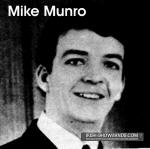
early 1967, Mike Mullen (stage name Munro and son of Dublin Labour
TD, Michael Mullen) joined the band to handle male vocals, replacing
(we think) Jim McManus. The band undertook their second tour in the United States, playing
for three weeks across the northeast and Canada.
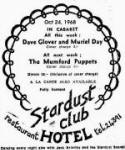
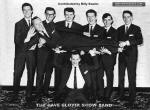
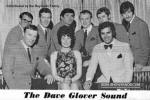
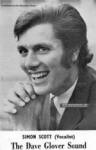
In April 1968, soon to be
Plattermen member, Simon Scott joined the band as lead vocalist along with
Muriel Day when M<ike Munro left to join the Chessmen. The next chapter in the band's history is a little
difficult to decipher. Apparently before the ink could dry on new
photos of the band featuring Simon Scott they disbanded. It appears that in
July, 1968, the band broke
up with Simon Scott going to the Plattermen. Jim Gunner joining the
Clipper Carlton and Dave and Muriel went
into cabaret (this reported in the March 8, 1969 issue of
Spotlight). However, in early 1969, Muriel was selected to
represent Ireland in the Eurovision song contest, a major break for
the her. She sang "Wages of Love" and headed off to Madrid for
Eurovision finishing a respectable 7th place.
A report in the Anglo Celt in
September reported that due to Muriel's success, Dave Glover was
putting another band on the road following her win. Dave had said that he thought it was a great
opportunity to put Muriel out front and would allow him to manage
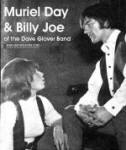
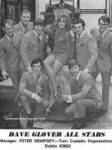
the band. In Spotlight magazine in September, 1969, an advert
announced Dave Glover was "back" with Muriel Day and Billy Joe as
lead singers. Then band would be managed by Peter Dempsey of the Tom
Costello Organisation. The line-up include returning members, Jim
Gunner (who had just previously been with the Old Cross Bandshow),
Johnny Anderson, Muriel and Dave. the newcomers were Billy Joe
(vocals), Adrian Mullen (keyboards - who would eventually join
Chips), Eddie McCann (bass) and Joe Trainor (drums). The band hit
the road in October.
In 1970, things were really
happening for Muriel. An article in the March 27th issue of
Spotlight reported that Muriel had done an hour long special on
BBC and that she had been booked for a series of shows that would
take her to all the big towns of the six counties in the North. The
series was slated to air beginning April 8, 1970. She was also
featured a few weeks later on the first episode of the RTE series
Girls, Girls, Girls. In October the band parted company with
manager Dempsey.
The end of the band came shortly
thereafter. In early 1971 Muriel and Dave split up and it is a
little difficult to tell what happened. One version is that the band went off to tour Canada and in the end,
Muriel and Dave split up with Muriel staying and Dave returning home
and the band went off the road. Muriel would stay in Canada for a
long time and eventually work in a medical office doing laser
procedures. The other version is that Muriel left Dave and the band
and headed off to Canada where she formed a band called the Knights
and would end up not returning to Ireland for many years. Dave
continued on the road with band, but moved into cabaret around
Belfast. We will research which story is correct.
Dave continued to play music well
into his 80's with his own jazz band. On the 27th of April, 2009,
Dave (aged 85) sadly passed away in Belfast bringing to an end one
of the most colourful careers of the showband era.
click on thumbnails for full image
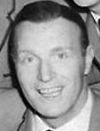 |
Dave Glover - RIP:
As a boy of 14, Dave sang in the choir at Whitehouse Parish
Church and dreamed of music as a career. But his mother
insisted on a trade he and his brothers set up Roundwood
Engineering which flourished for years in the city before
the family sold out. Eventually, Dave did move into music
and became of of the era's best loved characters. His second
wife, Muriel Day, became a household name in 1969 when she
came fourth in the Eurovision Song Contest with Wages Of
Love. Teddie Palmer told us that Dave was playing
regularly with his jazz band up until the year before his
death. Claiming to be the first to use the word, "showband,"
to describe their band, Dave sadly passed away April 27,
2009. |
 |
Alex Burns: If you
know more,
please let us know. |
|
|
Joe Clarke - RIP:
We understand Joe sadly
passed away. If you
know more,
please let us know. |
|
|
Harry "Trixie" Hamilton: |
|
|
Davy Martin: If you
know more,
please let us know. |
|
|
Harry Mitchell: If you
know more,
please let us know. |
|
|
Gerry Rice: If you
know more,
please let us know. |
|
|
Andy Wilson: If you
know more,
please let us know. |
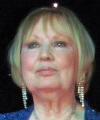 |
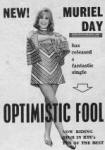
Muriel Day: In
December, 2013, we received an email telling us Muriel has
released a new country single in Ireland. Her new manager,
Malcolm McDowell, told us she has been the landlady of a
busy gastro-pub, sold real estate in Canada and even set up
a laser therapy clinic. She is now back doing what she loves
best, singing and is looking forward to a 32 county tour of
Ireland in 2014. Her new country CD is on the way as well.
In early 2015 Muriel was once again a featured performer on
the David Hull Promotions concert series, "Do You Come Here
Often." |
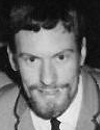 |
Jim Gunner - RIP:
Sadly, Jim has passed
away. If you
know more,
please let us know. |
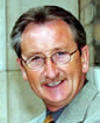 |
George Jones:
After a successful showband career, George first broke into
radio came with a Sunday slot on Downtown Radio. He went on
to work for the BBC, appearing mostly on radio. He had his
own show, Just Jones, for BBC Radio Ulster, which won
him a Sony Radio Academy Award for best local radio
presenter. In June 2006, George moved to Sunday mornings on
U105 and as of 22 January 2007 he presented his own show on
the same station from Mondays to Fridays from 3 to 6p.m.
However he then presented the Sunday night show on U105,
Sunday Sizzler, 6pm to 9pm, until early 2012. He remains one
of the era's most popular entertainers and a regular on the
David Hull "Do You Come Here Often" concert series. |
|
|
Dessie McCarthy: If you
know more,
please let us know. |
 |
Simon Scott - RIP (aka
Ivan Vaughn ): Simon
went on to sing with the Plattermen and then the Apaches as Big Chief in the late
70's. More recently, he was singing around the North as a
one man band but was tragically killed in flooding during
Storm Desmond on Dec 7, 2015. |
|
|
Jim McDermott: If you
know more,
please let us know. |
|
|
Johnny Anderson: If you
know more,
please let us know. |
|
|
Jim Armstrong: Jim
wrote us in June, 2021 to say he had left the band and
emigrated to Canada by 1966.
"I emigrated to Alberta, Canada in July
1966 and then moved to Vancouver, British Columbia in
1968 where I continued my musical career with various
bands. If you need further info feel free to get in
touch. Cheers!
Jim" Our thanks to Jim for the update.
. |
|
|
Ricky Parke: |
| |
Band Member: |
| |
Band Member: |
| |
Band Member: |
| |
Band Member: |