Folk/Traditional/Cabaret Artists
Currently listing 239 Folk/Cabaret Artists with many more to
come!
Photos A-C
Photos D-H
Photos I-M
Photos N-R
Photos S-Z
759 Photos to date.
 As the
showband era and the legacy of the British Beat groups began to wane across the
world, Ireland's slumbering folk scene was revived.
Although Ireland's folk and traditional music had a long and deep history, it
had been put on the back burner during the heady days of the ballrooms. Unlike
Ceili music, folk wasn't really for dancing, and in the 60's and 70's there
weren't many concert venues available across the country.
As the
showband era and the legacy of the British Beat groups began to wane across the
world, Ireland's slumbering folk scene was revived.
Although Ireland's folk and traditional music had a long and deep history, it
had been put on the back burner during the heady days of the ballrooms. Unlike
Ceili music, folk wasn't really for dancing, and in the 60's and 70's there
weren't many concert venues available across the country.
Folk and traditional hadn't gone away during those years, it
was just relegated to the small confines of pubs and lounges where "sessions"
were a regular part of life. On the national scene, the music had taken a back
seat to the showbands, country, and pop groups. In fact, many folk singers were
enticed by the lure of the ballroom scene and several embarked on ill-fated
"showband-like" excursions into the ballrooms.
Despite this, the resurgence of Irish folk and traditional music can trace
it's roots back to the late 1950's and early 1960's. Back then, Ireland had to
export much of it's music to the rest of the world, especially Canada and the
United States. Groups like The Chieftains, Clancy Brothers, and others,
regularly toured the world with their rousing choruses, traditional reels and
jigs and drinking songs.
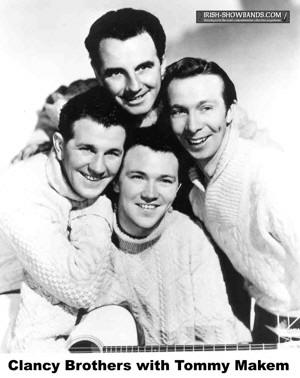 It
was actually the Clancy Brothers that were first on the scene. In the mid
fifties, Liam Clancy and Tommy Makem emigrated to the United States in an
attempt to become actors. With Liam's brothers, they formed the Clancy Brothers
with Tommy Makem and after an appearance on the legendary Ed Sullivan Show (the
same show that broke The Beatles in the USA), the group was launched into
stardom. They were one of the many groups that enjoyed success during the folk
revival of the early sixties which included the likes of Peter, Paul and Mary,
among others.
It
was actually the Clancy Brothers that were first on the scene. In the mid
fifties, Liam Clancy and Tommy Makem emigrated to the United States in an
attempt to become actors. With Liam's brothers, they formed the Clancy Brothers
with Tommy Makem and after an appearance on the legendary Ed Sullivan Show (the
same show that broke The Beatles in the USA), the group was launched into
stardom. They were one of the many groups that enjoyed success during the folk
revival of the early sixties which included the likes of Peter, Paul and Mary,
among others.
In Ireland in 1962,
Paddy Moloney (an uillean piper from
Dublin), met up with traditional musicians Martin Fay (fiddle), Seán Potts
(tin whistle), Micheal Tubridy (flute), and David Fallon (bodhrán) to record
a one-time album for the Claddagh label under the title of The Chieftains.
The musicians all knew each other from playing in Seán Ó Ríada's folk
orchestra, Ceoltóirí Cualann. The groundbreaking album
was released in 1963 and reflected a new approach to playing
traditional Irish music through interpretation and arrangement. Their
contribution to Irish traditional music, as well as those of Ó Ríada, were
to influence all musicians who followed.
At around the same time,
The Dubliners started off in O'Donoghue's pub in Dublin
under the name of "the Ronnie Drew Folk Group". Then they were four, Ronnie
Drew (vocals and guitar), Luke Kelly (vocals and 5-string banjo), Barney
McKenna (tenor banjo, mandolin, melodeon and vocals) and Ciarán Bourke
(vocals, guitar, tin whistle and harmonica). In 1964, John Sheahan joined
(fiddle, tin whistle, mandolin, concertina, guitar and vocals) forming what
would be the core group. In 1967 their major
breakthrough came when their song, "Seven Drunken Nights," was played by a
pirate radio station alongside the Beatles and Jimi Hendrix, making the The
Dubliners a major band.
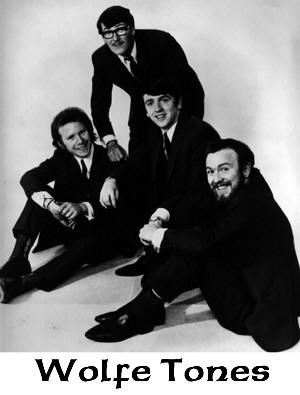 In
1963, two brothers from Inchicore,
Derek and Brian Warfield teamed up with
friend Noel Nagle and the Wolfe Tones were born. Playing at fleadhs around
Ireland, a year later they met singer, Tommy Byrne, and the group was
complete. Over the next few years, The Wolfe Tones grew from strength to
strength, riding the same wave of the Irish folk revival as their better
known contemporaries, The Dubliners. The Tones were a little different
though, in that they mostly built their reputation on "rebel songs" and
songs of protest. Today, although Derek has left the band, they continue to
tour internationally. Pictured at left around 1965, the Wolfe Tones look
every bit the picture of an Irish showband!
In
1963, two brothers from Inchicore,
Derek and Brian Warfield teamed up with
friend Noel Nagle and the Wolfe Tones were born. Playing at fleadhs around
Ireland, a year later they met singer, Tommy Byrne, and the group was
complete. Over the next few years, The Wolfe Tones grew from strength to
strength, riding the same wave of the Irish folk revival as their better
known contemporaries, The Dubliners. The Tones were a little different
though, in that they mostly built their reputation on "rebel songs" and
songs of protest. Today, although Derek has left the band, they continue to
tour internationally. Pictured at left around 1965, the Wolfe Tones look
every bit the picture of an Irish showband!
Into the early 1970's, this was "Irish" music to most
of the world. However, in Dublin in the late sixties, a quiet revolution was
in the making. Sweeney's
Men were the first of the "modern" folk-traditional Irish groups, and had a
huge impact on the Irish folk scene. In the late sixties, the
band injected fresh instrumental ideas into their music. The original line
up was Andy Irvine, Johnny Moynihan and Joe Dolan (not the showband
singer) who was replaced by Terry Woods in 1967. Their instrumentation
included bouzouki, guitar, banjo, mandolin, tin whistle, harmonica, and
concertina. This combination would set the scene for the dawning of a new
age in Irish music.
Around this time, Christy Moore, after
attending Newbridge College in Co. Kildare, went to work in a bank for three
years and during the bank strike of 1966, he went to England to work on the oil
rigs in the North Sea. When the strike ended, Christy came back to Ireland,
collected his back pay, and returned to England determined to make it as a folk
singer. In 1970, he met record producer Bill Leader in London and together they
came to Prosperous, Co. Kildare, to make a landmark album. Christy recruited
Donal Lunny, another native of Newbridge, Liam O'Flynn (an uilleann piper from
Kill, Co. Kildare), and Andy Irvine from Sweeney's Men. The lineup was augmented
with Clive Collins on fiddle, Dave Bland on concertina and Kevin Conneff on
bodhran. The album 'Prosperous', recorded in the basement of Christy's sister's
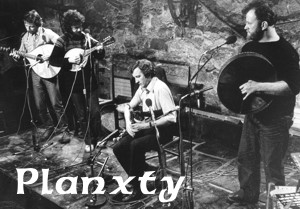
house proved to be the birth of Planxty.
 After Planxty, things were never to be the
same for Ireland's folk/traditional scene. The influences of people like Christy Moore, Liam O'Flynn, Andy Irvine, Paul Brady, Matt Molloy, Donal Lunny, (all members of Planxty at one
time or another) and others, would define the genre for a generation.
After Planxty, things were never to be the
same for Ireland's folk/traditional scene. The influences of people like Christy Moore, Liam O'Flynn, Andy Irvine, Paul Brady, Matt Molloy, Donal Lunny, (all members of Planxty at one
time or another) and others, would define the genre for a generation.
The rise in popularity of this new breed of
folk also gave rise to the explosion of Folk Festivals that dotted the Irish
countryside for more than a decade. Massive crowds migrated to places like
Ballisodare and Lisdoonvarna to enjoy ample helpings of this new, exciting form
of Irish music. Through the 1970's, more bands joined the folk revival in
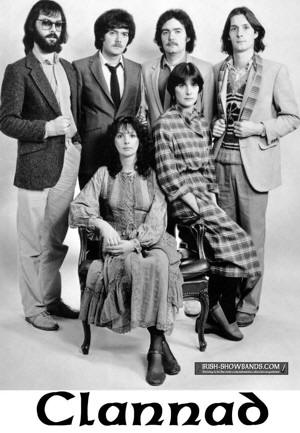
Ireland including names like The Bothy Band, De Danann, and Clannad. In fact,
Clannad enjoyed international success when one of their songs, Theme from
Harry's Game, became a major hit record in the U.K. Since then they have gone on
to become one of Ireland's top acts, as well as their former member, Enya, who
has enjoyed even more success with her approach to "new age" pop music.
The culmination of the growth of
Ireland's traditional music scene came in 1994 when Bill Whelan's
original composition, Riverdance, was performed during the
"interlude" of the Eurovision Song Contest in Dublin. Needless to
say, the performance of Michael Flatley and Jean Butler, along with
Whelan's inspirational orchestrated "traditional" score took the
world by storm and the rest is history. The success of Riverdance
across the globe has taken Irish music to a whole new level of
worldwide popularity and acceptance and continues to be a major
influence on the international entertainment scene.
Meanwhile, another form of
entertainment was enriched by the influences of the showband
era, cabaret. As the showbands were breaking attendance records
across the country in the early 1960's and the folk boom was
happening, a new type of venue began to emerge, the singing lounge
or cabaret room. These venues were more than just pubs and although
they started in the larger cities and towns, they soon spread to
every corner of Ireland, competing for the crowds that had once been
the exclusive "property" of the ballrooms.
Folk acts like Johnny McEvoy and
Danny Doyle were the first to dominate the cabaret landscape, but
soon they were joined by former showband stars like Butch Moore and
Sonny Knowles. Singers like Alma Carroll and Dana, who would never
make it on the dance-oriented ballroom scene, found fame and success
in cabaret. Soon all type of novelty and comedy acts (like the Rib
Ticklers and Brendan Grace) found homes on the cabaret scene.
Eventually, when the ballrooms died away in the early 80's, all that
seemed to be left was cabaret and country and western clubs, until
the theatre boom of the 1990's.
Click here for Folk/Trad/Cabaret Group photo gallery (all the photos so far in our collection).
Click on band name (if highlighted) to see photo.
|
Aileach/P2
[Donegal] (Donegal
based folk group from the mid 1970's) |
|
Albany Brothers/P2 [Letterkenny]
(brothers
John, George, P.J. and Jim
McManus) |
|
Alma Carroll [Unknown]
(late 60's early 70's cabaret and TV star) |
|
Apples
featuring Joe O'Toole [Dublin]
(We think this is Joe's band after leaving the
Dixies and the
showband scene) |
|
Arcady (featured
Sharon Shannon among others) |
|
Aslan/P2
() |
|
Bachelors [Dublin]
(formed
in 1957 they had many hits in the sixties in the UK) |
|
Bards [Dublin]
(Diarmuid
O'Leary started the band
as a folk act in mid-70's, but it is now a comedy trio) |
|
Barleycorn
[Belfast] (formed in 1970, had big
hit with "Men Behind the Wire" in 1972, disbanded in 1995) |
|
Margaret Barry
[Cork] (billed as the "Singing Gypsy
Lady," she toured the ballroom in the late 50's and early 60's) |
|
Mary Black/P2/P3
[Dublin] (One of Ireland's best loved
and most enduring female vocalists)
website |
|
Barley Cove Folk/P2/P3/P4/P5
[Cork]
(Fran Kellegher, Ted and Bernie Williamson and Connie Draper) |
|
Barnbrack/P2
[Unknown] |
|
Big Four
[Derry]
(featured Pat McGeegan) |
|
Blackthorn
[Dublin] |
|
Black Velvet/P2 [Unknown]
(Early 70's 3 girl group with Joyce Howard,
Loretta Grattan and Clodagh Carroll) |
|
Blarney
Folk
[Dublin] (Sixties folk group - Eugene
Byrne, Mick O'Brien and Brian O'Brien) |
|
Bloom [Unknown] |
|
Blondell [Dublin]
(Acoustic folk quartet of the early 70's) |
|
Blossoms/P2 [Cavan?]
(Acoustic folk trio of the early 70's) |
|
Bluebell
Quartet/P2/P3 [Cork]
(60's 4 piece) |
|
Bluegrass
Roadshow [Dublin]
(short lived bluegrass quartet formed by George
Kaye from his band Real Country - 1971) |
|
Boomerang [Unknown]
(3 piece group) |
|
Boru /
P2 /P3
[Arklow] |
|
Bothy Band (Formed in 1974
and lasting only 5
years, one of the best of the "new" Irish traditional bands) |
|
Boys of the Lough (Formed in 1967) |
|
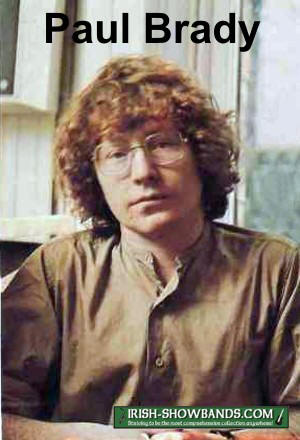
Paul Brady/P2
(originally in The Johnstons & Planxty, before
breaking out a a major solo artist and songwriter)
website |
|
Broadsiders/P2/P3/P4/P5 [Unknown]
(Featured Deidre Downes) |
|
Anne Byrne
[Unknown] (Married
to Paddy Roche and formed a group with Mick Crotty circa 1967) |
|
Alma Carroll
(Cabaret singer who came to prominence in the late 60's) |
|
Casement (Gabriel
Whyte writes to tell us the group played Dublin's folk scene from
1968-70) |
|
Celtic
Storm [Unknown]
(3 piece group) |
|
Celts, The
[Dublin] (3 piece
ballad competition winners in 1969) |
|
Ceoltóirí Cualann (Seán Ó Ríada's
folk
orchestra from the early 60's) |
|
Charlie
McGettigan [Ballyshannon]
(from bluegrass group Jargon won Eurovision) |
|
Cherish
The Ladies
|
|
Chieftains
(formed in 1962 from members of
Seán Ó Ríada's folk orchestra, Ceoltóirí Cualann) |
|
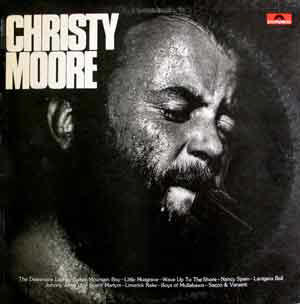
Christy Moore [Newbridge]
(founding member of Planxty and a major
influence on modern Irish folk)
website |
|
Chuck
Winter [Unknown]
|
|
City
Trio [Dublin]
|
|
Clancy Brothers With Tommy Makem
(formed in
late 50's in the United States) |
|
Clannad
[Gweedor] (the Duggan and Brennan
families of Gweedore, Co. Donegal formed in 1970)
website |
|
Mary Clifford /
P2 [Unknown] |
|
Coll's
Collection [Mullingar]
(four piece group featuring Christy Coll) |
|
Coterie Folk [Unknown]
(Pauline Byrne, Jacqueline McDarby & Catherine
Donnelly -all girl group of the late 60's) |
|
Craftsmen [Unknown]
(3 piece group) |
|
Craigarran Folk Duo [Belfast]
(late sixties folk group) |
|
Crescendoes, The/P2/P3 [Dublin]
(early 70's cabaret - Pat Doyle and Stephen
McQuillan) |
|
Croppies/P2/P3
[Unknown] |
|
Crubeen/P2/P3
[Unknown] |
|
Crystals/P2/P3 [Unknown]
(4 piece cabaret act featuring Joe O'Hehir) |
|
Cuchulain [Unknown]
(traditional group) |
|
Joe Cuddy [Dublin]
(came on the Dublin cabaret scene in 1968) |
|
Cufflinks [Laois]
(early 70's cabaret duo) |
|
De Dannan (band formed in 1975: Frankie
Gavin, Charlie Piggot, Alec Finn and Ringo McDonagh) |
|
Dingle Spike
[Kerry]
(Paul Theasby, Terry Conlon, Jack McCarthy, Jimmy O'Brien & Kevin
Conlon, album in 1978) |
|
Jim Doherty Trio [Dublin]
(late sixties trio) |
|
Eileen Donaghey [Coalisland, Co.
Tyrone]
(late fifties ballad singer toured the
ballrooms) |
|
Doves/P2/P3/P4 [Unknown]
(we do not know them, but think they were a
cabaret act) |
|
Danny Doyle [Dublin]
(late 60's folk singer turned
showband star in the early 70's) |
|
Geraldine Doyle [Dublin]
(late 60's folk singer - Danny's
sister) |
|
Dragoons/P2/P3 [Unknown]
(late 60's four piece folk group -
Liam & Pat Lynch, Dominic Burke & Mairead Connolly) |
|
Dublin
City Ramblers [Dublin]
(formed in mid 1960's, "Dublin in the Rare Auld
Times" was their biggest hit)
website |
|
Dubliners [Dublin]
(Probably Ireland's most successful and best
loved folk act) |
|
Dubliners
with Paul and Paula [Unknown]
(5 piece group) |
|
Pecker Paddy Dunne [Unknown] |
|
Dynamics, The [Unknown]
(two piece group) |
|
Early Birds [Ardee, Co. Louth]
(late sixties group) |
|
Emeralds, The
/P2 [Dublin]
(late sixties folk group lead by Michael
Murray) |
|
Emmet-Spiceland [Dublin]
(formed by Donal Lunny, Brian Bolger, Brian and
Michael Byrne) |
|
Jackie
Farn [Unknown]
(Mr. Cordovox) |
|
Farran
Folk [Farranshone]
(early 70's folk group: Damien Patterson, Tommy
Canty, Dave Browne and Tommy Cremins) |
|
Angela Farrell [Portadown]
(19 year old who represented Ireland in
Eurovision in 1971 with "One Day Love") |
|
Fenians, The [Mayo]
(late sixties folk group: Donal Benson, Terry
Griffin and Eugene Owens) |
|
Fiddler's
Green/P2 [Kildare]
(mid eighties folk group: John McGarrigle,
Jimmy Gallagher, Noel Brady & Danny Carthy) |
|
Foster and Allen/P2 [Athlone]
(one of Ireland's best loved folk groups
started in mid-70's) |
|
Four Ambassadors [Unknown]
(four piece cabaret act) |
|
Four
Men and A Dog [Unknown]
(five piece ballad group) |
|
Four
Ramblers/P2
[Unknown]
(four piece ballad group) |
|
Freemen, The [Northern Ireland]
(four piece ballad group of the early 70's) |
|
Furey
Brothers with Davey Arthur [Unknown] |
|
Bridie Gallagher/P2/P3
[Donegal]
(one of Ireland's first female superstars in
the late 50's and early 60's) |
|
Gallagher
Brothers [Unknown]
(three piece ballad group) |
|
Galtee
Folk Group [Unknown]
(four piece ballad group of the late 60's) |
|
Gamblers, The [Unknown]
(four piece ballad group of the late 60's) |
|
GEMS Group [Unknown]
(three piece ballad group of the late 60's) |
|
Gingermen, The [Dublin]
(four piece cabaret group featured Brendan
Grace in the late 60's) |
|
Noel V. Ginnity/P2 [Dublin]
(late 60's folk singer turned comedian) |
|
Gleemen [Unknown]
(Featured a very young Phil Coulter) |
|
Glenfolk Four [Unknown] |
|
Golden Boys [Unknown] |
|
Golden Dawn [Unknown] |
|
Go Lucky Four/P2* [Belfast]
(folk group from the 60's) |
|
Brendan
Grace [Dublin]
(without a comedy section, this is the best
place for Ireland's top comic singer) |
|
Grehan
Sisters [Dublin]
(three sisters folk group from the 60's) |
|
Harmony
Suite/P2/P3
[Dublin]
(four piece featured Joe
O'Toole, who would join the Dixies) |
|
Harp
of Erin
[Unknown]
(four piece) |
|
Ritchie Harrington/P2 [Dublin]
(solo folk singer around Dublin the late 60's
went on to Irish Travellers) |
|
Harvest
Three/P2
[Unknown]
(three piece) |
|
Shay Healy
(started life as a folk singer/journalist) |
|
Heir
[Dublin]
(1973 five piece - Tony
Boland, James Connolly, Terry Hanlon, George Brady and Ray Dolan) |
|
High Country
[Unknown]
|
|
High Level Rangers
[Unknown]
|
|
Larry Hogan
(formerly a member of We Four) |
|
Homers
Knods/P2/P3
[Arklow] (late 60's
folk trio managed by Dragoons' Liam Lynch) |
|
Hyland Paddy
[Unknown] (on
the road in the late 70's and early 80's) |
|
Inionach
[Unknown] |
|
Ireland's 32
[Unknown] |
|
Irish
Travellers
[Dublin] (band formed in
early 70's) |
|
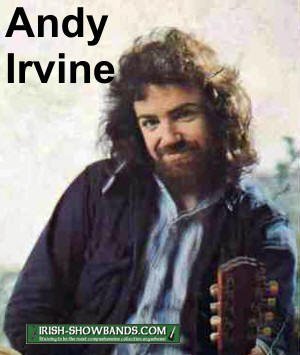
Andy Irvine
(originally came to prominence in
Sweeney's Men and later Planxty and as a solo artist)
website |
|
Ivy Folk/P2/P3
[Dublin]
(Tom and Mary Greally, Cecil Whitty
and Billy Buckley) |
|
Jacobites
[Dublin] (Late
60's folk duo - Tony Mooney and P.J. Crowe) |
|
Jargon/P2
[Sligo] (70's and
80's folk/bluegrass group
started by Eurovision winner, Charlie McGettigan) |
|
Johnstons* (60's folk group
that at one point was joined by Paul Brady) |
|
Jolly Beggermen
[Unknown] |
|
Jolly
Tinkers
[Dublin]
(late
60's folk group) |
|
Helen Jordan
[Dublin] |
|
Just Four
[Kildare] (formed
in March 1973 - Des and Billy Hopkins, Arthur O'Neill and Jimmy Byrne) |
|
Oliver Kane
[Dungannon] (started
as a folk singer) |
|
Kasuals
[Unknown] |
|
Hedley Kay
[Unknown] |
|
Heather Kaye
[Unknown] |
|
Dolores Keane/P2/P3
[Galway] (started
a member of De Dannan in mid 70's before going solo) |
|
Keltic Wine (band formed in
mid 1973) |
|
Kentuckians
[Belfast] (played
in the mid 1960's) |
|
Kinsfolk
[Limerick]
(late sixties group featuring Eugene and Teresa
Wallace) |
|
Chris Ledger
[Unknown] |
|
Jon Ledingham
[Drogheda]
(Toured folk circuit in mid 60's. Emigrated to
England and now Jonathan Kelly) |
|
Leprechauns
[Unknown] |
|
Liffey
Folk/P2/P3
[Dublin]
(late 60's 4 piece folk act) |
|
Liffeysiders
[Unknown]
(mid 60's folk group
featuring Donal Lunny) |
|
Lincoln Folk
[Dublin]
(60's - 70's folk group
from Dublin) |
|
Locke, Josef
[Unknown] |
|
Loudest Whisper
[Cork] |
|
Lowlanders,
The
[Dublin?] |
|
Ludlows*/P2/P3/P4/P5/P6
[Unknown] (60's
folk group which featured Jim McCann, Margaret Ludlow, Gerry Cairns) |
|
Majella/
P2
[Unknown] |
|
Makem and Clancy (Tommy Makem
and Liam Clancy of the Clancy brothers) |
|
Magnets
featuring Felim
[Unknown] |
|
Liam Maguire/P2
[Unknown] |
|
Joe Maguire and the Northerners
[Unknown] |
|
Rennie Maguire Show Group
[Unknown] |
|
Tony
Malone
[Unknown] |
|
Mara Lynn
[Unknown] |
|
Jim McCann/P2/P3/P4
[Dublin]
(eventually joined the Dubliners) |
|
Johnny McCauley Trio
[Unknown]
(One of the era's best known songwriters) |
|
Johnstons
[Slane]
(Came on the scene in the mid 60's and later featured Paul Brady) |
|
Marshalls
[Unknown] |
|
Maura
[Unknown] |
|
Nando and the
Marylanders
[Westmeath] (late
1960's group) |
|
Maxi,
Dick & Twink
[Dublin]
(Ireland's first "girl band") |
|
Brian McCollum Group
[Newry]
(Formed in 1966) |
|
Johnny McEvoy
[Offaly]
(First Irish solo vocalist to top the Irish
Charts started in the mid 60's) |
|
Anna
McGoldrick
[Dublin] |
|
Denis
McGrath
[Dublin] |
|
McLoughlins, The [Waterford]
(late 60's 3 piece family folk group - Joe and
Bernie McLoughlin and Jim Duggan) |
|
McLynn's Old Market Street
[Sligo]
(siblings Donal, Barbara and Paula McLynn with
Alan Zeserson) |
|
McTaggarts [Cork]
(late 60's family folk group) |
|
Midnight Well
/P2 /
P3 [Sligo]
(Tom Moore's late 70's follow up band to
Pumpkinhead-disbanded in 1979) |
|
Mighty Haymakers [Unknown] |
|
Misty [Unknown]
(cabaret act featuring Mattie Fox) |
|
Mitchell County Ramblers [Unknown]
(featured George Kaye of the Smokeys) |
|
Montyr Folk [Unknown] |
|
Moonlighters [Unknown] |
|
More [Belfast] |
|
Morriseys [Unknown] |
|
Mormonaires [Unknown] |
|
Moving Hearts/P2/P3/P4
(created the Celtic/jazz fusion sound in 1981, paving the way for Riverdance in 1994) |
|
Maeve Mulvany [Dublin]
(One time "Queen of the Ballads) |
|
Noel Murphy [Unknown] |
|
Ruby Murray [Belfast]
(One of Ireland top female vocalists of the 50's
and 60's) |
| Mushroom
(short lived mid 70's Celtic rock group featuring Aonghus McNally on lead guitar)
|
|
Musketeers /
P1 /
P2 [Cork] |
|
Na Casaidigh [Unknown] |
|
Na Sultoiri [Dublin]
(4 piece, Robert & Derek Harrington, Geraldine
Whelan and Sean Og McKenna - late 60's) |
|
Neary Brothers [Foxford] |
|
New Entry /
P2 [Unknown] |
|
Night and Day [Dublin]
(duo that play folk clubs in 1967-68) |
|
Nitrax [Arklow]
(trio from Arklow played folk clubs in mid 70's) |
|
Nita Norry
/ P2 [Dublin]
(female vocalist of the late 60's) |
|
Northern Lights Country
Band [Dundalk]
(three piece cabaret act from the mid 80's) |
|
Dermot O'Brien Trio [Dublin]
(one of Ireland's greatest cabaret stars) |
|
Maura O'Connell [Dublin] |
|
Al O'Donnell [Dublin]
(one of the earliest pioneers of the Irish folk
revival) |
|
O'Dowda, Brendan/P2
[Unknown] |
|
Oisin
/ P2
[Unknown]
|
|
Jesse Owens/P2 [Dublin]
(Late 60's folk singer) |
|
Ormonde Folk Group/P2 [Kilkenny]
(Late 60's trio folk group) |
|
Owen Roe Folk
[Unknown] |
|
Paddy's
Return
[Kilbeggan] |
|
Pathfinders [Dublin]
(Late 60's folk group) |
|
Pattersons [Letterkenny]
(Bill, Ronnie, Dorothy (RIP) and Christine formed in
1965) |
|
Noel Pender
[Donegal] (Late
60's folk artist fronted the Peep O'Day Boys) |
|
Planxty/P2/P3/P4/P5
(One of the greatest folk/trad groups of all
time, formed by Christy Moore) |
|
Poteen/P2
[Unknown]
(4-5 piece) |
|
Press Gang
[Dublin]
(late 60's four piece) |
|
Pumpkinhead/P2/P3
[Sligo]
(early 70's Sligo group featuring Tom & Cathy
Moore) |
|
Raglan Four
(mid 80's folk group) |
|
Quare Fellas
[Dublin] (late sixties group - brothers Sean and Matt
McGuinness, Patsy Watchborn, and Pat Cummins) |
|
Ramblers Two
[Dublin]
(mid sixties duo of Johnny McEvoy and Mick
Crotty) |
|
Paddy Reilly / P2
/ P3
[Dublin]
|
|
Reflections
[Cookstown]
(5 piece) |
|
Reflections/P2
[Longford]
(3 piece) |
|
Reunion
/ P2
[Unknown] |
|
Rib Ticklers
[Dublin]
(Gerry Daly, Tony McDonnell, (Brendan Byrne?) and Tommy
Duffy -
70's comedy mime act) |
|
Roy D and the Kentucky Four
[Unknown] |
|
Ryan's Daughters
[Unknown] |
|
Saga
[Dublin]
(Andy Pollard, Fred Johnston and Donie Dixon -
70's folk group) |
|
Sands
Family [Newry] |
|
Scullion/P2
[Unknown]
(3 piece group) |
|
Shades of MacMurrough
[Wexford]
(Paul Kavanagh, Josephine and Mary O'Neill) |
|
Cyril Shane
[Unknown]
|
|
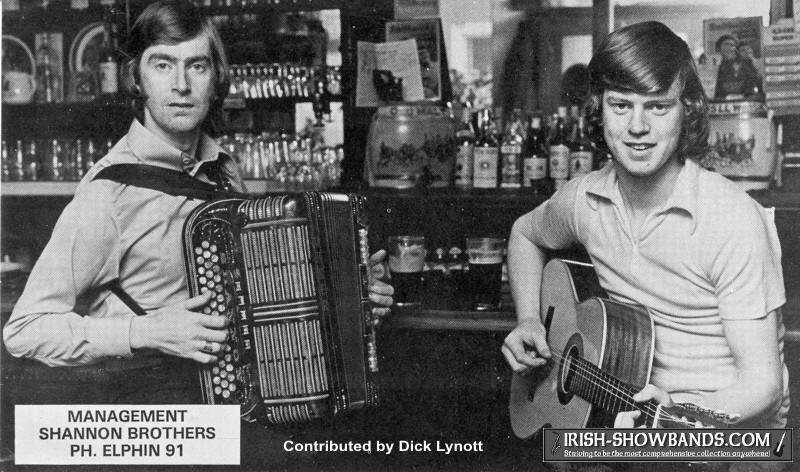
Shannon Brothers/P2
[Athlone] |
|
Shaskeen/P2
[Unknown]
|
|
Showstoppers
feat. Art Supple/P2/P3
[Cork]
(Art's cabaret group) |
|
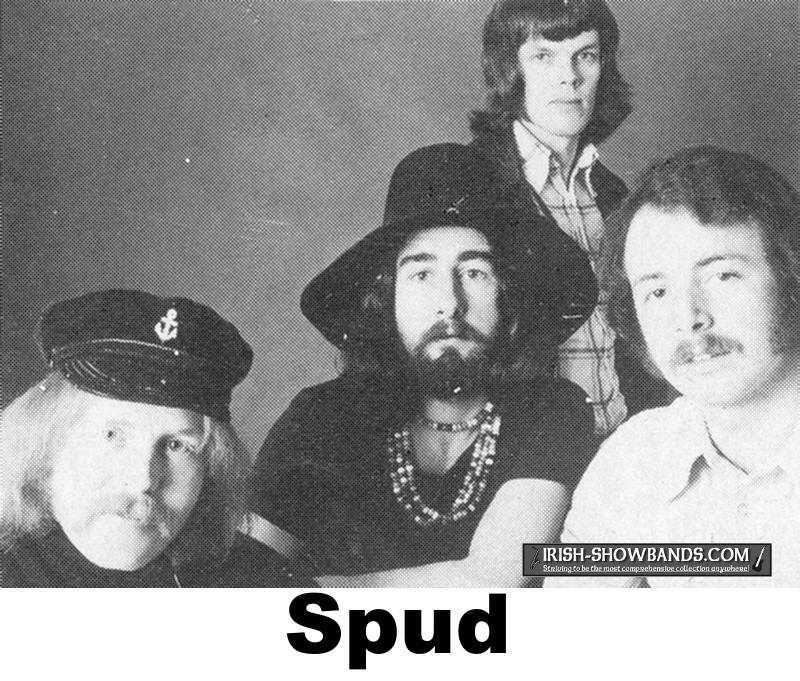
Spud
[Dublin]
(formed in 1973 from Thatch - had huge hit with
"Wind In The Willows") |
|
Stockton's Wing |
|
Stoker's Lodge |
|
Stout |
|
Sunshiners
[Ballyshannon] (4
piece group)
|
|
Swinging Jarveys
[Unknown] (Popular
in Gleneagle Hotel, Killarney in 60's-Patrick Hoye)
|
|
Sweeney's Men
[Dublin] (formed
in 1966 - Joe Dolan, Johnny Moynihan, and Andy Irvine)
|
|
Teamwork
[Unknown]
|
|
Des
Tracey Quartet
[Unknown]
|
|
Thatch
[Unknown] (Early
70's Terry McAloon, Lennie Power, Brendan Jameson and Dessie Flaherty)
|
|
The Thompsons
[Unknown] (Folk
group from the late 60's)
|
|
The Tinkers
[Unknown] (Folk
group from the late 60's)
|
|
Travellin' Folk
[Dublin] (Folk
group from the late 60's)
|
|
Tudor
[Unknown] |
|
Twice
As Nice
[Dublin] (late
70's cabaret duo featuring Tony James and Veronica Jones -sister of
Sandie)
|
|
Two's Company/P2/P3/P4
[Killarney] (Folk
duo of Eamonn McRory and Mary Darcy formed in 1967)
|
|
Values,
The/P2/P3
[Unknown] (Folk
duo)
|
|
Velvet Poetry
[Unknown] (Folk
group from the early 70's played Sligo Live '71)
|
|
Villagers,
The
[Unknown] (Folk
trio)
|
|
Sonny
Ward Band
[Galway] (Formed
after leaving the Swallows)
|
|
We Four
[Unknown] (late
60's quartet - Larry Hogan, Suzanne Murphy, John Harrington and Dennis
Mowatt)
|
|
Weavers, The
[Dublin] (Not sure
if they are the same band as the Weaver Folk) |
|
Weaver Folk
[Dublin] (Had a
minor it with "Henry My Son" in 1968 that reached number 19 in the
charts) |
|
Adrienne
Webber [Dublin] (Folk
singer from late 60's) |
|
Westonairs [Dublin] (Folk
group from mid 60's) |
|
Whiskey Styl
[Dublin] (Folk
group managed by Cotton Mill Boy's Gerry Madigan in mid 70's) |
|
Willows,
The
[Limerick] (Folk
group managed by Sean Gleeson from Limerick) |
|
Wilson,
Terry/P2
[Dublin] (Folk
singer) |
|
Wolfe Tones
(Derek and Brian Warfield, Noel Nagle & Tommy Byrne made a career
singing rebel songs) |
| More to come! |