1950's - In The Beginning
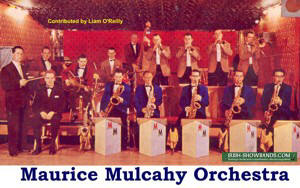 The basis for the showbands comes from the
"orchestras" that traveled the length and breadth of Ireland during
the whole of the 20th century, and before. In the years between the
end of World War II (know as 'The Emergency" in neutral Ireland) and
the late 1950's, names like Maurice Mulcahy, Johnny McMahon, Tony
Chambers and Brose Walsh led 10 to 18 piece orchestras in which musicians sat
behind music stands and respectfully played a wide selection of
music from big band standards to Irish folk and even Ceili
music...very dignified!
The basis for the showbands comes from the
"orchestras" that traveled the length and breadth of Ireland during
the whole of the 20th century, and before. In the years between the
end of World War II (know as 'The Emergency" in neutral Ireland) and
the late 1950's, names like Maurice Mulcahy, Johnny McMahon, Tony
Chambers and Brose Walsh led 10 to 18 piece orchestras in which musicians sat
behind music stands and respectfully played a wide selection of
music from big band standards to Irish folk and even Ceili
music...very dignified!
To some degree, this form of wholesome
entertainment satisfied Ireland's dancing public. There was
something for everyone. Formal attire was mandatory and most
orchestras wore Dickie bows and tuxedos. A few adventurous bands
even tried colored blazers. The key for the orchestras, to some
extent, was to be "all things to all people" and to their credit
they generally did that very well.
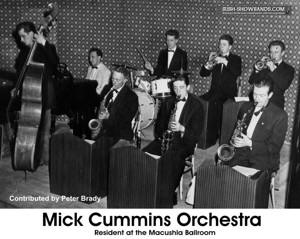 Many of these orchestras were actually the
resident bands in the larger ballrooms around the country. Most of
the bands were semi- professional as many of their members
worked day jobs in addition to their nightly gig. In fact, in later
years the move
to "turn pro" was often the most difficult for musicians who had
cherished their ability to play music without the rigorous grind of
being on the road.
Many of these orchestras were actually the
resident bands in the larger ballrooms around the country. Most of
the bands were semi- professional as many of their members
worked day jobs in addition to their nightly gig. In fact, in later
years the move
to "turn pro" was often the most difficult for musicians who had
cherished their ability to play music without the rigorous grind of
being on the road.
Due to the nature of their gigs, the bands read
music and not only played the top hits of the day, but also backed
a variety of guest artists, further requiring their flexibility when
it came to musical styles.
Overall, for many people, the orchestras
represented the "cream of the crop" of Irish musicians. A reflection of the times
in Ireland, simple and inoffensive, they provided good, wholesome
entertainment to an extremely conservative audience. With the
dawning of the showbands, this musicianship became an even bigger
issue.
Writing in the Irish Pictorial (which
became the Irish Times) a reporter who called himself
Dancealot wrote the following about the "new" showbands in 1957.
"It seems to have been my unhappy lot recently in the course of duty
to suffer from several Showbands, who if they intended making a SHOW
of themselves could not have been more successful. I'm not opposed
to showbands generally...but lately I've been unlucky. I heard three
or four bands in a row and could find nothing good to say about any
of them! The bands in question reached an all time low musically,
the sounds they made being appalling." He finished the scathing
review with the following: "Which goes to show that you can get a
percussionist who can belt the skins and cymbals hard and loud
enough to provide a jive beat, gather together indifferent musicians
who fancy themselves as singers who can busk on musical instruments
and you're in the Showband business!"
At the same time (and for many years
previously), the Roman Catholic Church and its clergy reigned supreme over
the people and politics of Ireland. Eamon De Valera, who was seen by
many to be Ireland's guiding light from the time of the Easter
Rising right up through his death believed devoutly that
the Catholic Church and the family were central to Irish identity.
This relationship between church and State would result in laws
which prohibited dancing on Saturday nights and nights before a
Church Holy day, as well as during Lent (with an exception, of
course, for St. Patrick's Day).
The instrumentation for the orchestras was
fairly standard, two or more saxophones, two or more trumpets, a
couple of trombones, a piano, accordion, drums and a double bass and possibly a
fiddle player. Bigger bands would also feature male and
female vocalists. In general, no guitars were to be seen, and they would become, in time,
the nemesis of the orchestra and would help hasten their downfall.
One of the main drawbacks for the orchestras (which would also
influence the eventual coming of the showband era) was a distinct
lack of technology in the form of amplification. Most halls were
very small during this period and a single microphone would be
provided for the bandleader, MC (Master of Ceremonies) or vocalists
to be heard. All piano and brass and woodwinds had to carry their
own sounds down the hall.
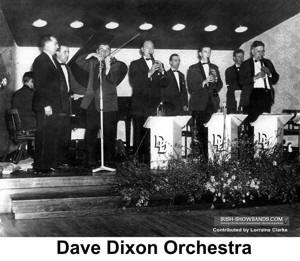 In
Northern Ireland (mainly Belfast and Derry), big bands and orchestras flourished, as did
the dancing scene before the "troubles" in the 1970's. Belfast
boasted many of the finest musicians on the island and bands like
Dave Glover's Band and the Clipper Carlton did very well, often
venturing down to Dublin where they suitably impressed the locals to
the South. Derry had Johnny Quigley, among others.
In
Northern Ireland (mainly Belfast and Derry), big bands and orchestras flourished, as did
the dancing scene before the "troubles" in the 1970's. Belfast
boasted many of the finest musicians on the island and bands like
Dave Glover's Band and the Clipper Carlton did very well, often
venturing down to Dublin where they suitably impressed the locals to
the South. Derry had Johnny Quigley, among others.
Two of these bands, in fact, were to have a
significant impact on the Irish entertainment industry as the 1950's
came to a close. Sometime in the mid fifties, some of the orchestras
started featuring "mini-shows," in the middle of the evening's dancing.
These shows usually took the form of comedy skits in which members
of the orchestra dressed up and mimicked the stars of the day. At
first introduced as a novelty, they soon became a staple, during
which dancers would stop and watch the band for a half hour or more.
One of the reasons for these breaks was the incredibly long hours
bands had to play. It was not at all uncommon for dancing to start
at 9:00 p.m. and last until 2 a.m. "Long Dances" could last up to
six hours.
At the same time, punters were growing weary of
the same old thing. Rock and roll had been born in the United States
and quickly spread to Britain. Bands like Bill Haley and the Comets
were jumping around on stage and lead singers wildly gyrated to the
delight of young fans. Legend has it that the Clipper Carlton
Orchestra (billed throughout the 1950's as Hugh Toorish and the
Clipper Carlton Orchestra) weree the first
band credited with kicking away their music stands in the mid 50's and
incorporating their regular feature "Jukebox Saturday Night" into
their act. Given what was happening in the UK and USA, it is not
surprising that this became the "next step" for dance bands.
Although the late
Dave Glover claimed to be the first used the term "Showband" in the band's name,
the origin of the term is still somewhat disputed.
In fact, during the mid to late 1950's bands were often referred to
as Orchestras, Dance Bands, Band Shows, and Show Bands. These names
seem to be used interchangeably at times. Over the course of several
months the same band might appear advertised under each of these
monikers. In fact, during this
period, several bands used the term, Band Show, to describe their
outfit. We have seen advertisements in old newspapers where other bands
were being described as Show Band while Dave Glover was still being
listed as an Orchestra. It is possible the truth will never be
known.
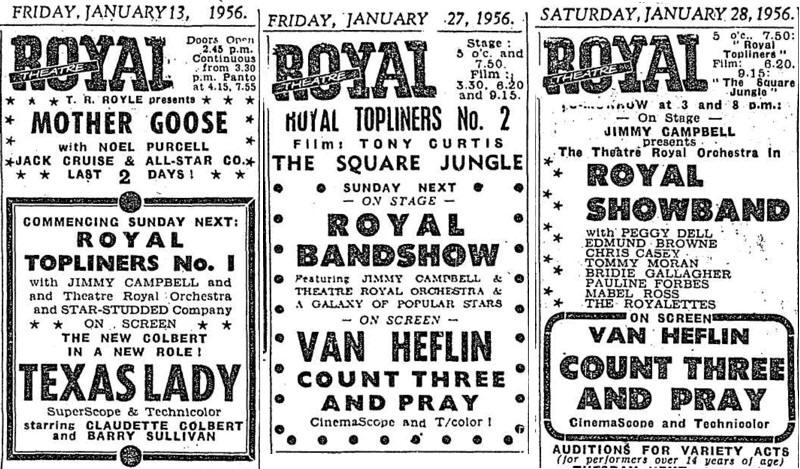
The first actual use of the term showband we
can find is in January, 1956. The Royal Theatre in Dublin started a
variety show between films after the close of their annual
pantomime, Mother Goose. Initially the variety show was advertised
as "Royal Topliners" with Jimmy Campbell and the Theatre Royal
Orchestra. Within two weeks, it had been renamed the "Royal
Bandshow" and the following night the name was finally changed to
the "Royal Showband." The term was used to describe a show vs. the
band which was still the Theatre Royal Orchestra.
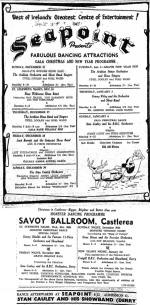
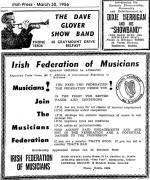 The
first instance we have found of the term "showband" being applied to
an actual band was in March, 1956 in an advert for the
"Dixie Merrigan and his Showband." On the
same page, there was an advert for the "Dave Glover Show Band." By the end of the year the term "showband" would begin to get used
around the country. (Click on images for full size).
The
first instance we have found of the term "showband" being applied to
an actual band was in March, 1956 in an advert for the
"Dixie Merrigan and his Showband." On the
same page, there was an advert for the "Dave Glover Show Band." By the end of the year the term "showband" would begin to get used
around the country. (Click on images for full size).
Interestingly, Dave Glover always insisted he
coined the term "showband" which is quite possible, but hard to
authenticate. The term Band Show had been in use which was then
switched to Show Band, but first the actual word Showband is
difficult to attribute to any one band or musicians as newspaper and
their typesetters, often used their own spellings when playing
adverts in those days, not to mention band name issues north and
south of the border. .
One way or another, across the country, on both sides of the border,
a new form of entertainment was being created. Many bands put away their sheet music and donned colorful suits, dancing
and jiving their way through the night's programme. In the south,
the Royal Showband, along with the
Dixielanders, and others began to
take their place at the top of the national scene. But the coming of
the showbands did not happen overnight. It would take several
years before the Showbands would make their presence felt in a
major way, especially across rural Ireland.
For a time, as with all change, the move away
from Orchestras towards Showbands was a hotly debated notion.
Traditionalists scoffed at the lack of musicianship and quality
exhibited by the showbands and their singers, while the showbands
mocked the formality and lack of excitement generated by the
orchestras. Not unique to Ireland, this was a revolution being felt
around the world as Frank Sinatra made way for Elvis and Glen Miller
for Bill Haley and the Comets.
In the end, what really mattered was the will
of the people (punters) who paid the admission to hear their
favourite bands, no matter they called themselves, but even m ore
importantly...to dance! One way or another, the showbands had arrived.....
Click here to continue
Click on one of the genres below to learn more.
